
So This Is Christmas
How to quiet the vampires, Serbia?

A Gen Y genius with a dry sense of humour who was born and raised in Serbia has long called her homeland ‘Srbistan’. Let’s call her Milica because it’s not her real name, and at the moment in Serbia attaching your name to statements may have more serious consequences than formerly. Milica studied political science at the University of Belgrade and grew up in the 1990s under the rule of Slobodan Milošević. She acutely resented the isolation of then-Yugoslavia from the wider community of nations during the Balkan Wars that broke up that wider federation. After Milošević was deposed in 2000, Milica’s first celebratory move was to buy plane tickets to almost everywhere. One destination was Iceland, or somewhere like Iceland – just for the inat of it.
Milica then worked in the Swiss banking industry. After that she collaborated with Serbs who’d done time in Silicon Valley to establish an unusually innovative IT venture, based in Belgrade and operating globally. Its backend was designed to enable easy relocation if Serbia ever became a suboptimal investment for her, and for people like her. I met Milica about ten years ago, when she was around thirty. Back then Serbia looked and felt very much freer, and Belgrade was a lot more fun – more the ‘poor man’s Berlin’ than the ‘poor man’s Dubai’. Milica pointed me to the newly erected statue to the Serbian writer and political activist Borislav Pekić, where she’d laid some flowers. She told me to read his book How To Quiet A Vampire:
The disquieting novel How to Quiet a Vampire is a rumination on terror and intellect in the tradition of Joseph Heller and George Steiner. Published to acclaim in 1977, Pekic’s novel of ideas follows Konrad Rutkowski, professor of medieval history and former Gestapo officer, as he returns to the scene of his war crimes determined to renounce, or perhaps justify, his Nazi past. In a series of letters, Rutkowski lays out his ambivalent reactions to war and violence, connecting his own swirling ideas to those of the major figures of European thought: Plato, St. Augustine, Descartes, Nietzsche, Freud, and others.
Delving far deeper than mere intellect, however, Borislav Pekić, was himself a frequent political agitator and occasional prisoner, and he drew on his first hand knowledge of police methods and life under totalitarianism to paint a chilling portrait of a supposedly free-thinking intellectual acting in the service of repression. At the same time he questions whether Rutkowski’s ideology puts him outside the philosophical tradition he so admires – or if the line separating European thought from totalitarianism is not as clear as we like to think.
People like Milica inhabit one of the few slices of contemporary Serbian society (outside of the mafia classes) that maintain a healthy cash flow and accompanying lifestyle options. Usually they are highly educated with skills that can be transferred to other nations and markets. They tend to be strong in STEM as much as humanities, including the women. They also tend to be highly entrepreneurial and often run their own businesses, and have bent over backwards to hold a strong professional presence in Serbia – where they employ local people. They follow Serbian politics at a granular level and are engaged with their local communities, but they do not run in elections for public office and nor do they bankroll candidates. They often own real estate in Belgrade or Novi Sad, often in the Serbian countryside as well if they were raised there, and sometimes also in Croatia, Montenegro or Bosnia and Herzegovina especially if their family had a footprint in those places in Yugoslav times. They are well connected at home and abroad and proactively use their networks to make their lives better.
Because of the deep political crisis in Serbia that’s now run for over a year, many are now activating or refreshing exit options. This crisis was triggered by a railway canopy collapse in Novi Sad on 1 November 2024 (see my earlier analysis on this Substack), which in turn triggered a national descent into ‘Huljistan’. Unlike nearby Bulgaria where large anti-corruption protests relatively quickly led to the government resigning earlier today, the Serbian standoff still shows no real sign of resolution.
Smart Serbs I know across generations are buying real estate in Athens, Thessaloniki or on a Greek island. Others are moving their Euros and similar to banks in jurisdictions outside Serbia, or putting cash under their beds. Those last moves looks astute as the energy security of the nation still isn’t guaranteed beyond mid-January 2026 – due to the complex geopolitics around US sanctions against Russia, which could lead to the collapse of Serbian provider NIS (majority owned by Russia’s Gazprom), and the even more complex flows of money through a matrix of backchannels. This past week has seen deep insecurity around foreign exchange, and nervousness from finance experts and citizens alike about an impending downwards slide of the Serbian dinar against the Euro – despite moves by Serbia’s central bank to calm that farm and dismiss ‘irrational’ panic.
A former Yugoslav friend of mine likes to quip that panic is merely the name of a Serbian general – Panić, get it? Cute joke. But here’s the real punchline about panic. By definition, it is irrational. If not, it is a wholly rational response to an accumulation of red flags, bristling danger warnings from all directions.
As 2025 limps to its end, this is how I see Serbia: standing at a point of super-saturation with truly scary warning flags. Flags not so much red in political alignment as fading to black. That is one point of enduring difference between post-World War II Yugoslav President Josip Broz Tito (unapologetically a communist, and after his split with Stalin in 1948 also emphatically non-aligned) and current Serbian President Aleksandar Vučić (whose belief system can seem incoherent and his allegiances elusive – but one consistent agenda has been a dedication to radical ultra-nationalism, often of the kind that would have spurred Tito to authorise banishment to the island prison of Goli Otok).
Across the past difficult year in particular, Serbia as a nation and as a people have rapidly and visibly become more economically isolated, politically divided and personally desperate than at any time in my lifetime. Arguably even including the 1990s, which was no walk in the park for anyone in the former Yugoslavia, and featured slaughter and torture and sanctions and hyperinflation and bombing and occupations and forced displacements, on a scale not seen in Europe since World War II. ‘Back in the 1990s we still had the legacy and memory of Yugoslavia to lose – a larger economy, our own industries, a sense of social cohesion connected with access to decent education, housing and health care,’ one local analyst said to me recently (off the record because, you know, the times), ‘And today we are sitting on thirty years of shameless stripping of public assets, an insane dedication to neoliberalism, and this disgusting turbofolk culture which is no culture at all, it is the worst kind of degradation and prostitution.’ Seeking explanations of the recent crisis, it’s always tempting to focus on the leadership style and method of Vučić. Increasingly ‘strongman’ authoritarian, illiberal, corrupt and militaristic; some have added more triggering adjectives like proto-fascist or kleptocratic or even pathocratic. But the truth is very much deeper and murkier than that. The question really isn’t so much what Vučić says and does. It’s more about how and why he has been able to capture so much of the public’s imagination inside Serbia for such a long time – love him or hate him, it’s a hypnotic performance, I’ve watched people I used to respect sit in their living rooms and be almost sexually seduced by his television persona – and at the same time effectively deflect due scrutiny from outsiders, including in the West’s left/liberal elite, who you’d think might know better.
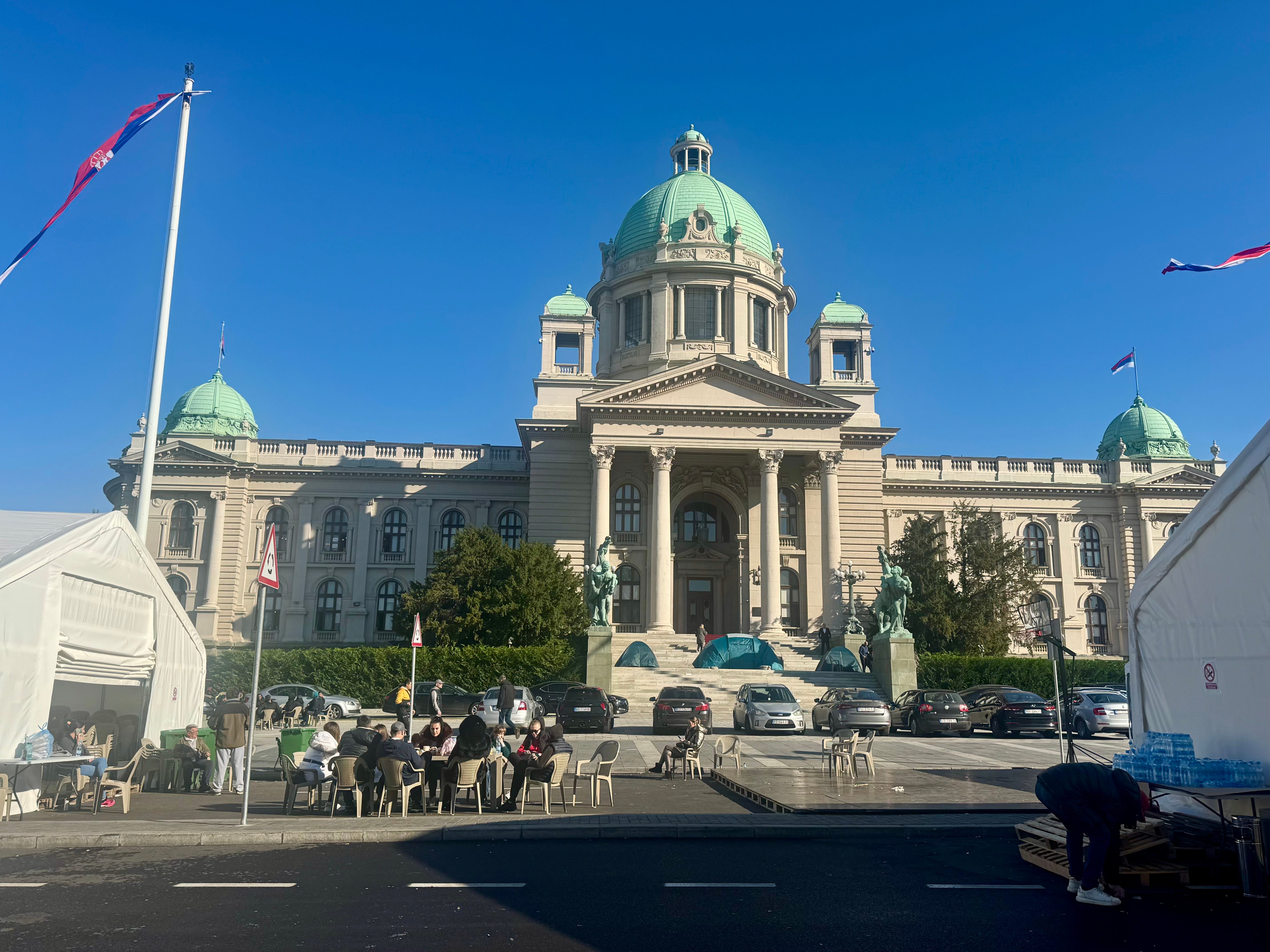
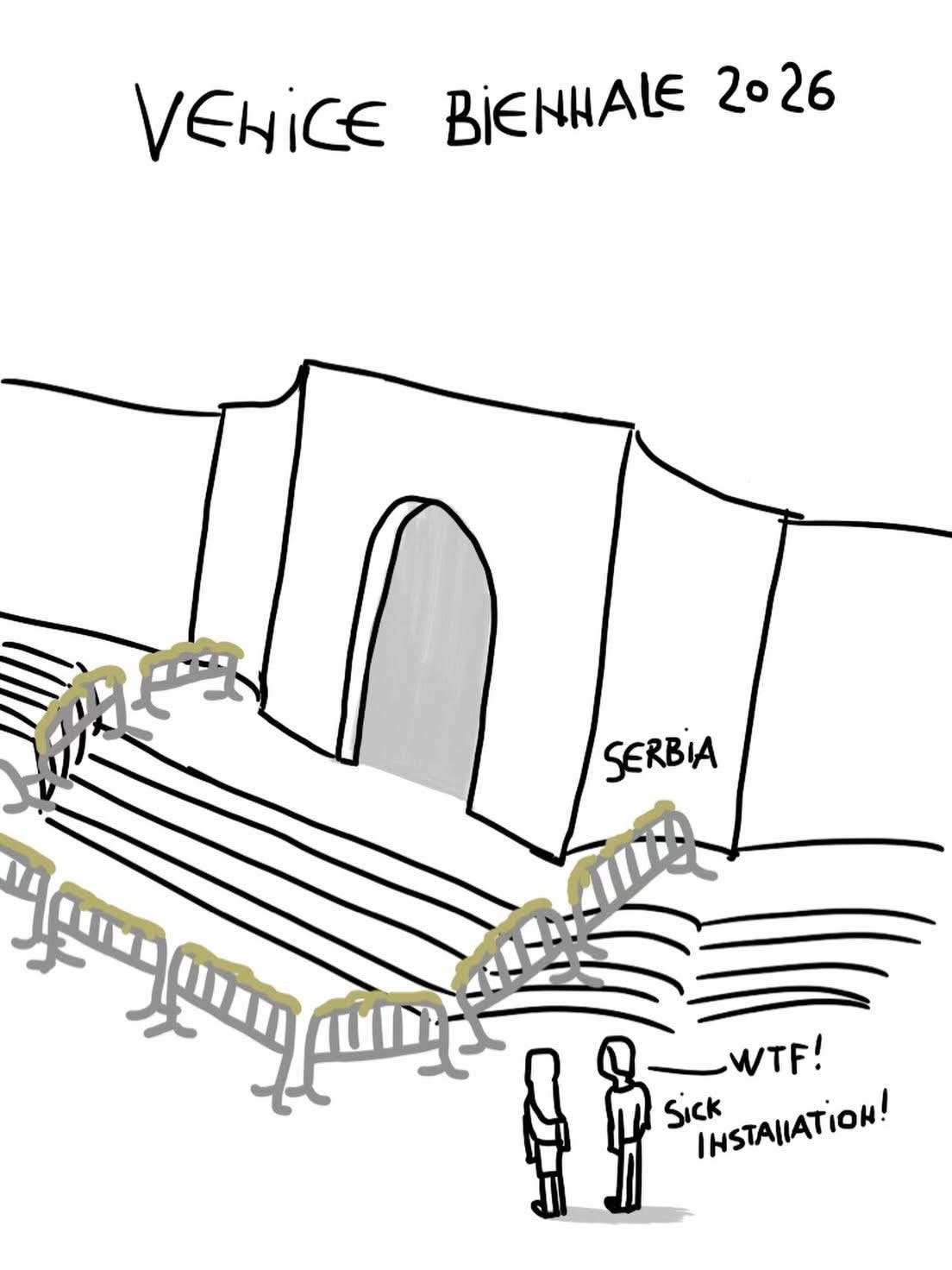
Sure, leading legacy media mastheads like The New York Times and Deutsche Welle and The BBC and The Guardian and Agence France-Presse and Le Monde (not so much Al Jazeera now, which unfortunately closed its Western Balkans operations a few months ago) have given space to Serbia this past year when things happened that really couldn’t be ignored. Like astoundingly large anti-government protests in Belgrade and Novi Sad and cascading smaller ones across most of Serbia (indeed the whole nation is still in a kind of shifting patchwork of permanent protest, and as a close friend in Belgrade said to me yesterday, ‘there could be a shitstorm on one street, and you can be having a coffee on the other street and not notice’); the alleged firing of an illegal sound cannon against crowds of demonstrators; the widespread use of state sanctioned violence and media censorship and SLAPP suits to suppress dissent; and the hunger strike by a mother of one of the canopy collapse victims outside the Ćacilend paramilitary encampment that now surrounds the Serbian parliament in Belgrade. You might assume the erection and maintenance by any government of an encampment of that kind (yes, paramilitary) anywhere in the world would be a standalone story? I did, so I bluffed my way into Ćacilend twice this year, once around Easter and once last month which was a very much tenser affair – to see for myself.
There won’t be a third time, including because a couple of nights earlier another colleague was smashed in his unusually recognisable face by police for turning up at a nearby protest, which gave me some pause. Also, because Vučić has now hinted that Ćacilend may be decommissioned. But I’ll believe that when the greased barricades are down and the riot police are pulled out and the spookily masked hooligans and armed criminals and mercenaries who have appropriated this public space have crawled back under their rocks or been sent (back) to prison. Trust me, it’s still a story.
Another story, I know, was the Instagram footage I saw the other day of kindergarten children in Belgrade pressed to their school fence, waving their little hands and fists – and chanting pumpaj! – to cheer people walking to the Palace of Justice. These protesters were supporting the nine university students arrested after June’s Vidovdan demonstration, and charged with attempting to overthrow the constitutional order.
To their credit, a group of United Nations human rights experts this year has issued statements of concern about Serbia’s democratic downswing, most recently on 5 December in relation to attacks on journalists. The European Union has been grindingly slow to say anything, despite sustained attacks on students, professors, judges, culture workers, bus drivers, indeed citizens of from all walks of life, as well as journalists. In practical terms, it has done nothing much beyond downgrading Serbia’s accession prospects so it’s now stuck in a logjam behind the Ukraine, Moldova, Montenegro, Albania, and it seems even Kosovo. The European Parliament has now announced it will send a fact finding mission to Serbia from 24 to 26 January 2026, I suppose there are carols to sing and festive trees to decorate and families to enjoy before they get there. And as I type, EU President Ursula Van Der Leyen has just met for more photo opportunities with Vučić in Brussels and brushed over his sotto voce comment to her that he had ‘a message from Moscow.’
So this is (almost) Christmas.
And what have you done?
Thank you
Lily Lynch does an update - https://open.substack.com/pub/lilylynch/p/serbias-vucic-enters-deeper-international?r=3bw11&utm_medium=ios